Monday, November 15, 2010

Term Review Schedule

First off, I want to say that your end-of-term exam will be quite challenging. It is based on actual past paper questions and will not be as straightforward as your two previous course assessments.

For the rest of the term, we will only be doing review of topics done so far for this term and if you pay attention these next couple weeks, you should have no problem excelling in the end-of-term exam. We have managed to complete 2/3 of the syllabus so far and it is now time to see which areas you are weak in and need to work on.

I have seen to it that every topic will be coming for your end-of-term exam, so it is unwise to omit studying any one particular topic that you may find difficult.... because it WILL come!

At the end of each class session, you will be given a short (15 - 20 minute) assessment of assorted past paper multiple choice and structured questions pertaining to the topic(s) taught at that session.

Mon November 15th - Cells, Movement of Particles
Click here to download the Cells assessment

Fri November 19th - Photosynthesis, Plant Nutrition (Enzymes worksheet for homework)
Click here to download the Photosynthesis assessment
Click here to download the Enzymes assessment

Mon November 22nd - Diet, Digestive System (Transport in Plants worksheet for homework)
Click here to download the Diet and Digestion assessment
Click here to download the Transport in Plants assessment

Fri November 26th - Respiratory System, Excretion, Homeostasis (Respiratory System assessment in class, Excretion/Homeostasis Assessment for homework)
Click here to download the Respiration assessment
Click here to download the Excretion/Homeostasis assessment

Mon November 29th - Circulatory System, Components of Blood
Click here to download the Circulatory System/Blood assessment


Fri December 3rd - Biology End-of-Term Exam.
20 Multiple Choice Questions (20 marks)
4 Structured Short Answer Questions (30 marks)
2 Essay-Type Questions (20 Marks)
Total = 70 Marks
Pass Mark = 49 / 70 (70%)
Time: 1 hour, 45 minutes.
Exam is based on every topic from Cells up to Homeostasis.
Remember, this is Form 5. This is a crucial time and we only have 5 months left before exams. Therefore, we must start preparing from now. You don't want to be left behind. If you study, you can do it. I am here to help you all the way. I have high expectations in you guys!


UPDATE: Download links will be added as we complete each worksheet.

Tuesday, November 9, 2010

Coordination and Response


This topic will be split in TWO class sessions:
  • Nervous System and the Brain
  • The Eye and the Hormone System

DOWNLOAD THE SLIDES FOR COORDINATION AND RESPONSE HERE!

YOU NEED TO KNOW HOW TO:


NERVOUS SYSTEM AND THE BRAIN
  1. State that the nervous system - brain, spinal cord and nerves - serves to coordinate and regulate bodily functions.
  2. Identify the central nervous system (CNS) on a diagram.
  3. Identify the following on a diagram of the brain: cerebrum, cerebellum, pituitary gland, hypothalamus, medulla, spinal cord, nerves.
  4. Describe the functions of the above named structures, and relate to how they each contribute to coordinating bodily functions.
  5. Outline the functions of sensory neurons, relay neurons and motor neurons.
  6. Provide a detailed outline on how a "reflex action/arc" occurs.

THE EYE AND THE HORMONE SYSTEM

  1. State the components of the EYE and their functions.
  2. State how the eye produces a focused image of near and distant objects.
  3. Describe the pupil reflex in response to bright and dim light
  4. define a hormone as a chemical substance, produced by a gland, carried by the blood, which alters the activity of one or more specific target organs and is then destroyed by the liver.
  5. State the role of the hormone adrenaline in boosting the blood glucose concentration and give examples of situations in which this may occur
  6. Describe the signs (increased blood glucose concentration and glucose in urine) and treatment (administration of insulin) of diabetes mellitus.

VIDEOS:

1. EXPLANATION OF NEURONS AND NERVOUS SYSTEM


2.
HOW THE EYE WORKS


3. THE HUMAN EYE (nice and simple!)


4. FUNCTIONS OF THE BRAIN


5. The Reflex Arc (simple and effective)


P.S. Congratulations to Krystal and Ishaan for having the two highest scores in the second course exam (95 and 90, respectively), and to Arvin and Vedish for having the two most improved scores (by 27 and 22 marks respectively).

Also, it is nice to note that the class average also improved, even though these were harder, more complex topics. Good job, and keep working!

Monday, October 25, 2010

Homeostasis


DOWNLOAD THE SLIDES FOR HOMEOSTASIS HERE!

YOU NEED TO KNOW HOW TO:
  1. Define the term homeostasis.
  2. Explain how homeostasis works in terms of NEGATIVE FEEDBACK.
  3. Outline the structure of the skin and be able to identify: hairs, sweat glands, blood vessels, insulating (or adipose) tissue, sebaceous glands.
  4. Explain how humans maintain a constant body temperature on hot and cold days.
  5. Explain how the pancreas regulates blood glucose levels and that the failure to do this is called diabetes.
VIDEOS:

1. HOMEOSTASIS EXPLANATION ANIMATION


2. ANATOMY OF THE SKIN


NEXT CLASSES:

- REVIEW AND QUESTIONS
- SENSE AND COORDINATION

Friday, October 22, 2010

Excretion

DOWNLOAD THE SLIDES FOR EXCRETORY SYSTEM HERE!

YOU NEED TO KNOW HOW TO:
  1. Define excretion as the removal of toxic materials and the waste products of metabolism from organisms.
  2. Describe the removal of carbon dioxide from the lungs.
  3. State that the skin is an organ of excretion and rids of waste via perspiration.
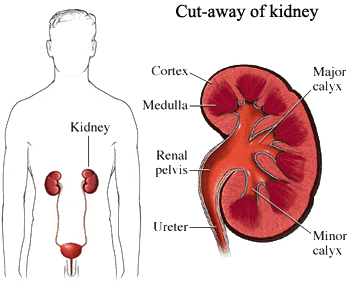
  4. Simply identify on diagrams of the nephron and urinary system: ureter, bladder, urethra, kidney, Malpighian corpuscle (Bowman's capsule), proximal convoluted tubule, loop of Henle.
  5. State that the function of the kidney is to simply remove urea and excess salts and water from the blood.
  6. Be able to state the functions of: ureter, bladder, urethra, kidney, nephron.
  7. Describe ultrafiltration and selective reabsorption.
  8. Describe dialysis in kidney machines.

VIDEOS:

1. URINARY SYSTEM (very informative!)


2. FUNCTION OF THE NEPHRON (informative!)


3. BASICS OF THE EXCRETORY SYSTEM CARTOON (terrible narration voice but good basic information!)


NEXT TOPIC:

- HOMEOSTASIS

Sunday, October 17, 2010

Respiratory System

DOWNLOAD THE SLIDES FOR RESPIRATORY SYSTEM HERE!

YOU NEED TO KNOW HOW TO:

  1. Define respiration as the release of energy from food substances in all living cells.
  2. Define aerobic respiration.
  3. State the word and symbol equations for aerobic respiration.
  4. State the uses of energy in the human body (muscle contraction, protein synthesis, cell division, active transport, growth, nerve impulse passage, body temperature, etc.)
  5. Define anaerobic respiration.
  6. State the word and symbol equations for anaerobic respiration.
  7. Describe the effect of lactic acid production in muscles during exercise.
  8. State differences between inspired and expired air; know the percentages of gases in the atmospheric air.
  9. State the effect of physical activity on breathing rate and depth.
  10. Label on a respiratory system diagram: trachea, bronchi, bronchioles, alveoli, capillaries, larynx.
  11. Describe the role of: cilia, diaphragm, ribs, intercostal muscles.
  12. Discuss gas exchange between the alveoli and capillaries.

VIDEOS:


1. RESPIRATION ANIMATION (very informative!)


2. OXYGEN TRANSPORT (very informative!)


3. VENTILATION ANIMATION (Diaphragm and Rib Cage Movement)


NEXT TOPIC:

- THE EXCRETORY SYSTEM

Monday, October 11, 2010

Transport in Humans - Circulatory System

DOWNLOAD THE SLIDES FOR CIRCULATORY SYSTEM HERE!

YOU NEED TO KNOW HOW TO:
  1. Describe the circulatory system as a system of tubes called arteries, veins and capillaries with a pump and valves to ensure one-way flow of blood.
  2. Describe why it is a "double circulation" system.
  3. Name the blood vessels that carry blood to and from the heart, lungs, liver and kidneys.
  4. Describe the structure and function of the heart in terms of muscular contraction and the working of valves.
  5. Compare the structure and function of arteries, veins and capillaries.
  6. Investigate and state the effect of exercise on pulse rate.
  7. Describe coronary heart disease, state possible causes and preventive measures.
  8. Be able to identify red and white blood cells from diagrams and microscope photographs.
  9. List the components of blood as red blood cells, white blood cells, platelets and plasma.
  10. State the functions of blood and the functions of each component in the blood (red blood cells are used for oxygen transport; white blood cells for antibody formation and phagocytosis; platelets for clotting; plasma for transport of the blood cells, digested food, waste material, etc.)
  11. Describe the transfer of materials between capillaries and tissue fluid.

VIDEOS and LINKS:

1. HEART ANIMATION SHOWING VALVES


2. CIRCULATORY SYSTEM ANIMATION (VERY INFORMATIVE)


3. THE COMPONENTS OF BLOOD (VERY INFORMATIVE)


NEXT CLASS:

- COMPONENTS OF THE BLOOD
- INTRODUCTION TO THE RESPIRATORY SYSTEM

Friday, October 8, 2010

Transport in Plants

DOWNLOAD THE SLIDES FOR PLANT TRANSPORT HERE!

YOU NEED TO KNOW HOW TO:
  1. Relate the structure and functions of root hairs to their surface area and water intake.
  2. Define "transpiration".
  3. Describe how water vapour loss is related to stomata and air spaces.
  4. Describe the effects of wind, temperature, humidity and light on transpiration rate.
  5. Describe how wilting occurs.
  6. Explain how water flows through the roots and stem using the terms "root pressure", "capillarity pull/capillary action" and "transpirational pull".
  7. Draw a section through a stem, labelling xylem, phloem, cambium and pith.
  8. State the functions of xylem and phloem.
  9. Relate the structure of the xylem and phloem to their functions.

VIDEOS and LINKS:

1. HOW THE PHLOEM WORKS

2. MOVEMENT OF WATER THROUGH PLANTS


3. TRANSPIRATION


4. XYLEM AND PHLOEM VIDEO PRESENTATION


NEXT CLASS:

TRANSPORT IN ANIMALS (CIRCULATORY SYSTEM)